


<img height="1" width="1" style="display:none;" alt="" src="https://px.ads.linkedin.com/collect/?pid=2923012&amp;fmt=gif">
Skip to content

Who Needs CMMC?

CMMC applies most directly to organizations that do business with the Department of Defense, support defense primes, handle Federal Contract Information, or process, store, or transmit Controlled Unclassified Information.

For many organizations, the challenge is not simply knowing whether CMMC matters. The challenge is understanding what part of the business may be in scope, how CUI moves through the environment, and whether the IT systems behind the organization’s policies can support the level of readiness required.

Rutter helps defense contractors, suppliers, and high-trust organizations prepare the technical foundation behind CMMC readiness, without replacing the formal assessment process or claiming to certify organizations.

Jump to the section that matches your organization.

July 2026 CMMC Phase II Update

The transition to CMMC Phase II is suspended while the program is under review. Phase I self-assessment requirements remain in place, and applicable procurements may require CMMC Level 1 or Level 2 self-assessments.

Organizations should continue protecting FCI and CUI, reviewing contract and flow-down requirements, maintaining applicable self-assessment records, addressing security gaps, and organizing supporting documentation and evidence.

Defense Contractors & Subcontractors  |  Aerospace & Defense  Government & Municipal IT  Construction IT Support  |  Healthcare IT & Security  Other Organizations  Signs You Should Start 

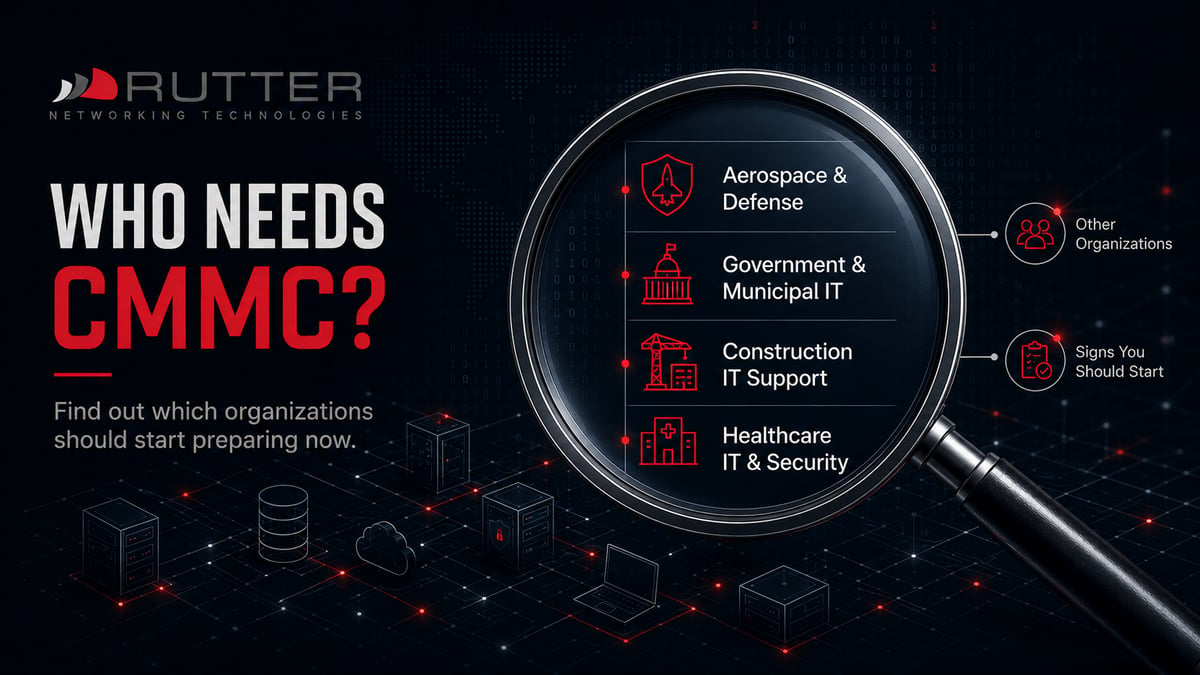
Rutter feature image showing which industries need CMMC, including aerospace and defense, government and municipal IT, construction IT support, healthcare IT and security, other organizations, and signs you should start preparing.

Who Should Pay Attention to CMMC?

CMMC may be relevant if your organization has a direct or indirect role in the defense supply chain, handles controlled information, or receives security requirements from customers, primes, or contracts.

CMMC may be relevant if your organization:

  • Contracts directly with the Department of Defense
  • Supports a defense prime contractor
  • Handles Federal Contract Information
  • Handles or expects to handle Controlled Unclassified Information
  • Receives CMMC or NIST SP 800-171 requirements from a customer
  • Responds to defense-related supplier questionnaires
  • Provides manufacturing, engineering, technology, logistics, or support services to the defense supply chain
  • Is preparing to bid on contracts that may include CMMC requirements
  • Needs to prove that security controls are implemented, operating, and supported by evidence

Even during the Phase II pause, your organization may need to understand its FCI or CUI exposure, current self-assessment requirements, security gaps, and infrastructure readiness path. 


Defense Contractors and Subcontractors

Defense contractors and subcontractors are the most obvious audience for CMMC readiness. These organizations may need to demonstrate that the systems supporting contract work are protected, managed, monitored, and documented.

Rutter helps these teams review the technical environment behind contract readiness, including identity and access controls, endpoint and device management, remote access, Microsoft 365 and Azure security configuration, backup and recovery practices, logging and monitoring, technical evidence routines, and CUI boundary considerations.

The goal is to reduce uncertainty during the current review period, before contract, customer, self-assessment, or future CMMC requirements make the work more disruptive. 

rutter cmmc sheild - cmmc compliance
rutter-cmmc-for-aerospace-industry-air and space cybersecurity compliance cmmc2.0.png

Aerospace & Defense Manufacturers

Aerospace and defense manufacturers often operate with engineering systems, production workflows, shared files, controlled technical information, specialized users, and hybrid infrastructure that cannot simply be moved into a new environment without careful planning.

For these organizations, CMMC readiness needs to support both security and production continuity.

Rutter helps aerospace and defense-adjacent manufacturers strengthen CUI and CTI handling practices, engineering workstation controls, identity and administrative access, endpoint compliance, backup and recovery, hybrid infrastructure governance, and evidence readiness for customer reviews, applicable self-assessments, and future assessment requirements. 

Rutter’s approach is practical: improve the environment you operate, reduce unnecessary scope where possible, and build the technical routines needed to support readiness.

Explore Aerospace & Defense IT Support
rutter-cmmc-for-government- departments-federal-dept-municipal-local-state-industry

Government & Municipal IT

Some organizations do not think of themselves as defense contractors, but still support government or prime contractor work. Suppliers, service providers, technology firms, manufacturers, and logistics partners may receive contract language, questionnaires, or security expectations tied to CMMC.

If your organization supports defense-related work, the first step is to understand what information you receive, where it lives, who can access it, and which systems may be in scope.

Rutter helps organizations clarify the technical side of readiness so leadership can make better decisions about scope, remediation, and modernization.t readiness.

Government and municipal organizations do not automatically need CMMC. CMMC becomes relevant when contract language, controlled information, defense-related work, or customer requirements bring CUI, FCI, NIST SP 800-171, or CMMC expectations into the environment.

Explore Government & Municipal IT
rutter-cmmc-for-construction-industry

Construction IT Support

Construction firms do not automatically need CMMC. However, construction organizations may need CMMC-aware infrastructure support when they perform defense-related work, support a prime contractor, handle controlled drawings or contract information, or respond to customer security requirements.

For construction teams, the larger readiness challenge is often operational: mobile devices, job-site access, shared files, remote users, project systems, backup reliability, and cyber incident recovery.

Rutter helps construction organizations strengthen endpoint control, secure remote access, Microsoft 365 governance, backup and recovery, monitoring, and evidence routines in a way that supports job-site realities.

Explore Construction IT Support
rutter-cmmc-for-healthcare-industry

Healthcare IT & Security

Healthcare organizations do not automatically need CMMC. However, healthcare, medical, research, or healthcare-adjacent organizations may need CMMC-aware support if they handle controlled information under a defense-related contract, support a DoD-adjacent program, or receive NIST-aligned security requirements from customers, partners, insurers, or regulators.

For these organizations, CMMC may not be the only driver. The same infrastructure issues that affect CMMC readiness also affect HIPAA-aligned security, ransomware resilience, uptime, identity control, endpoint management, backup reliability, and evidence readiness.

Rutter helps healthcare and healthcare-adjacent organizations strengthen secure operations without disrupting clinical or administrative workflows.

Explore Healthcare IT & Security
Untitled design (1)-4

Other Organizations That May Need CMMC-Aware Support

CMMC may also become relevant for technology providers, logistics partners, professional services firms, managed service providers, regulated manufacturers, and other organizations that support defense-related work or handle controlled information.

These organizations may not describe themselves as defense contractors, but contract language, customer requirements, supplier questionnaires, or CUI workflows can still create technical readiness needs.

Rutter helps organizations evaluate whether CMMC-aware IT support is needed, where controlled information may live, and which technical gaps should be addressed during the current review period. 

Talk to Rutter About CMMC-Aware IT Support
  • A prime contractor has asked about CMMC or NIST SP 800-171
  • Your contract mentions CUI, FCI, DFARS, or cybersecurity requirements
  • Your team is unsure where CUI lives
  • Microsoft 365, Azure, endpoints, backups, or remote access are not consistently governed
  • You have policies, but limited technical evidence
  • Your internal IT team is stretched thin
  • You are preparing to bid on defense-related work
  • You are not sure whether your current environment would stand up to scrutiny
shutterstock_2739579187

CMMC Readiness Next Step

Find Out Whether Your Environment Is CMMC-Ready

Whether you are handling FCI or CUI, completing an applicable self-assessment, preparing for defense work, or responding to contract or customer requirements, Rutter can help you understand your technical readiness path.