Who Needs CMMC?
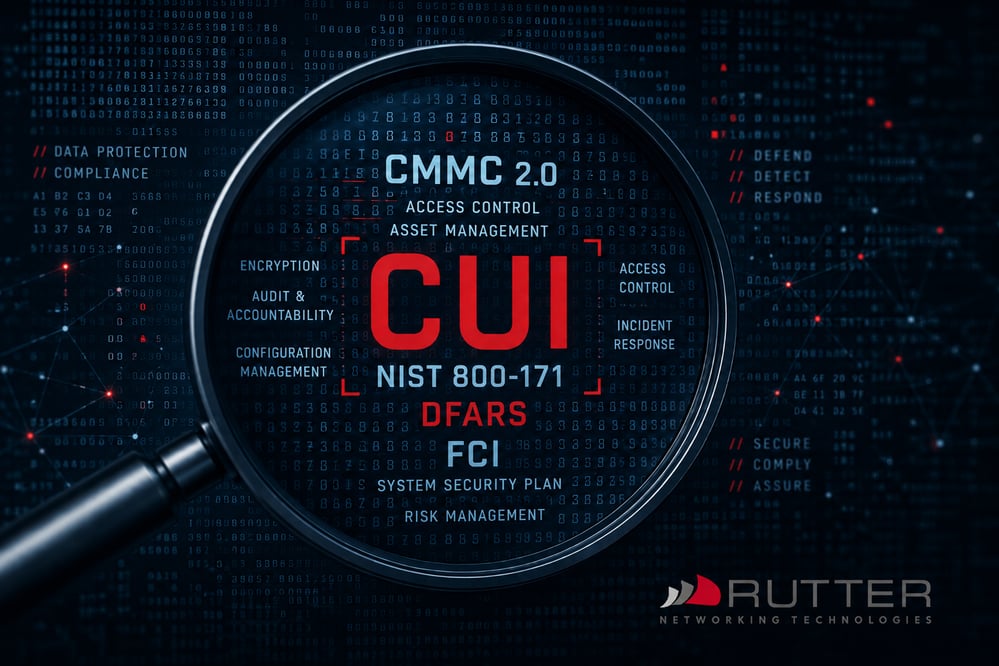
Not every organization follows the same CMMC path, but contractors and suppliers connected to the defense supply chain need to understand how CUI, FCI, contract language, and customer expectations affect readiness obligations.
CMMC readiness is not just a documentation exercise. For defense contractors, aerospace manufacturers, government suppliers, and organizations handling Controlled Unclassified Information, the real challenge is making sure the IT environment behind the paperwork is ready.
Your users, endpoints, identity controls, cloud systems, backups, logs, access policies, and evidence routines all need to support the same story: security controls are implemented, operating, and defensible.
Rutter helps organizations prepare the technical foundation behind CMMC Level 2 readiness. We do not certify your organization, and we do not replace the role of a C3PAO. We help build, secure, document, and manage the environment that makes readiness cleaner, more organized, and less disruptive.

Use this hub to understand the infrastructure, security, and operational readiness issues that support CMMC preparation. Start with the topic closest to your current need, or request an assessment if you need a direct readiness conversation.

Not every organization follows the same CMMC path, but contractors and suppliers connected to the defense supply chain need to understand how CUI, FCI, contract language, and customer expectations affect readiness obligations.

CMMC readiness is easier to manage when the process is structured. Learn how Rutter helps organizations review scope, evaluate infrastructure, identify gaps, prioritize remediation, and build repeatable evidence routines.

Policies alone do not make an organization ready. Explore the technical areas that need attention before assessment pressure increases, including identity, endpoint management, logging, backup, access control, monitoring, and evidence support.

Microsoft Azure, Azure Arc, Entra ID, Intune, and related Microsoft security tools can support stronger visibility, governance, identity control, and hybrid infrastructure management when configured around CMMC readiness needs.

Access Rutter guides, blogs, case studies, webinars, FAQs, and related infrastructure resources to better understand the technical foundation behind CMMC readiness.
Start with a readiness conversation.
Rutter can help identify where your environment stands, what may be in scope, and what technical gaps should be addressed before assessment pressure increases.
Fill out the short form below and someone from Rutter will reach out to you shortly.

We start by helping your team understand where CUI may exist, which systems may be in scope, and where technical controls need to apply.
We assess identity, endpoints, cloud services, remote access, backup, logging, monitoring, and core infrastructure against CMMC readiness expectations.
We identify what needs to be fixed first, what can be improved over time, and what may require process, documentation, or third-party support.
We help turn technical controls into repeatable evidence. That may include access reviews, device compliance exports, configuration records, monitoring reports, backup validation records, and change documentation.
Rutter can continue supporting the environment after remediation, helping keep controls aligned as users, systems, contracts, and business needs change.

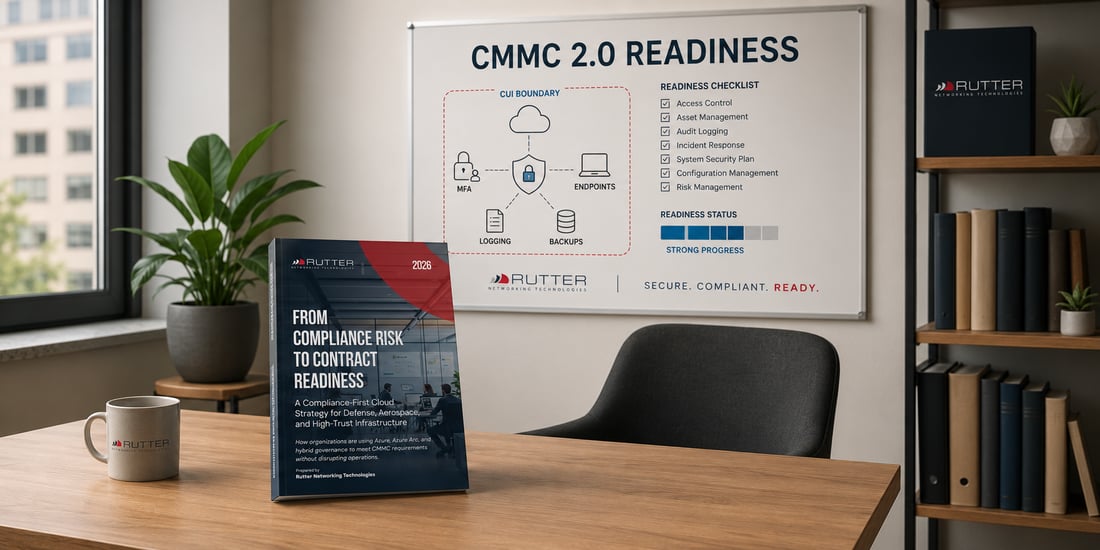
Modern defense, aerospace, and regulated manufacturing organizations need infrastructure that can support modernization, security, and CMMC readiness without disrupting operations.
This guide explores how Microsoft Azure, Azure Arc, and hybrid cloud governance can help improve visibility, strengthen operational control, and support audit-ready infrastructure across distributed environments.
Inside the guide, you will learn:
CUI Scoping
Identity Controls
Endpoint Management
Azure Governance
Logging & Monitoring
Backup & Recovery
Evidence Readiness
Remediation Planning
Many organizations approach CMMC as a policy problem. That is only part of the picture.
Before readiness can be evaluated, your organization needs to understand where CUI lives, how it moves, who can access it, how systems are protected, and whether the required evidence can be produced consistently.
That is where many teams get stuck. Common issues include:
CMMC readiness requires more than written policies. Organizations must be able to show that security controls are implemented, operating, and supported by real evidence.

If you do not know where CUI comes from, where it goes, where it is stored, and who manages it, your assessment boundary can become larger than necessary. That can increase cost, complexity, and remediation time.
Rutter helps organizations review CUI flow, identify potentially in-scope systems, and support a more precise readiness roadmap.
CMMC readiness depends heavily on access control. MFA, privileged access, user lifecycle management, conditional access, administrative separation, and account review processes need to be aligned with the environment.
Rutter helps strengthen identity controls across Microsoft 365, Entra ID, remote access, administrative accounts, MFA, conditional access, and user lifecycle processes.
Laptops, workstations, mobile devices, shared devices, and remote users create risk when they are not consistently managed, encrypted, patched, monitored, and governed.
Rutter helps standardize endpoint security using tools such as Microsoft Intune, device compliance policies, encryption, patching, and secure configuration baselines.
Even when controls exist, many organizations cannot easily produce the logs, reports, screenshots, review records, configuration evidence, and recurring documentation needed to support assessment readiness.
Rutter helps turn technical controls into repeatable evidence routines that can support internal reviews, customer questionnaires, readiness conversations, and formal assessment preparation.
Ransomware resilience and recovery readiness matter. Backups must be protected, tested, and aligned to business continuity expectations, not treated as an afterthought.
Rutter helps review and improve backup, recovery, and resilience practices so your organization is not relying on untested assumptions during an incident or readiness conversation.
Rutter helps prepare the operational and technical side of CMMC readiness.
We help identify where sensitive information may live, how it flows through your environment, and which systems may be in scope. The goal is to reduce uncertainty and support a more precise readiness roadmap.
We help strengthen identity and access controls across Microsoft 365, Entra ID, remote access, administrative accounts, MFA, conditional access, and user lifecycle processes.
We help standardize endpoint security using Microsoft Intune, device compliance policies, encryption, patching, endpoint protection, and secure configuration baselines.
We help organize the technical evidence your environment should be able to produce, including access records, configuration reports, endpoint posture, alerting data, backup validation, and recurring review documentation.
We help review and improve backup, recovery, and resilience practices so your organization can reduce downtime, validate recovery assumptions, and support operational continuity.
After identifying gaps, Rutter helps prioritize remediation by business risk, assessment impact, technical dependency, operational disruption, and available resources.
CMMC readiness does not end after initial preparation. Rutter can support ongoing IT operations, monitoring, endpoint management, security maintenance, and evidence routines so controls continue to operate after the initial readiness push.
We help evaluate your current IT environment against CMMC Level 2 and NIST 800-171 readiness expectations, identify technical gaps, and organize a practical remediation plan for CUI protection, access control, logging, backup, and evidence readiness.

Audit-ready IT. Evidence-ready operations. Minimal disruption.
Rutter helps aerospace and defense-adjacent manufacturers strengthen security controls, improve evidence readiness, support customer scrutiny, and align infrastructure with high-trust supply chain expectations.

Job sites do not stop. Your IT should not either.
Construction firms may need CMMC-aware support if they support defense-related projects, primes, or controlled information workflows. Rutter supports construction companies with endpoint management, cyber incident response, cloud access, business continuity, and mobile workforce security designed for job-site reality.

Always-on systems. Strong security. Calm operations.
Healthcare organizations do not automatically need CMMC, but healthcare-adjacent organizations supporting government or defense work may need CMMC-aware planning. Rutter supports healthcare and healthcare-adjacent organizations with managed IT, cybersecurity, device management, backup, recovery, vendor coordination, and compliance-aligned operations.

Reliable operations. Resilient infrastructure. Security that holds up under public-sector expectations.
Government and municipal organizations do not automatically need CMMC, but they often face public-sector security expectations, NIST-aligned requirements, vendor scrutiny, and operational continuity pressure. Rutter supports these organizations with IT operations, infrastructure resilience, security monitoring, identity hardening, backup, disaster recovery, and modernization planning.
Rutter has supported organizations for more than two decades with secure, scalable IT infrastructure solutions.
We help organizations architect environments that perform, scale, and withstand risk. Our work commonly includes:
Rutter works with leading enterprise technology providers, including Microsoft, VMware, AWS, Cisco, Check Point, and others, to deliver secure, practical infrastructure solutions for organizations with high operational and security demands.

Rutter is not a C3PAO and does not certify organizations for CMMC.
Our role is to help your organization prepare the infrastructure, security controls, operating practices, and technical evidence that support readiness.
A formal CMMC assessment must be performed by an authorized assessment organization where required. Rutter can help your team get organized before that process begins and support remediation after gaps are identified.
This distinction matters.
Rutter supports technical readiness, infrastructure alignment, remediation, evidence preparation, and ongoing managed operations. Formal certification must be handled through the appropriate CMMC assessment process.

Start Here
Whether you need a direct CMMC readiness conversation, a practical Azure modernization guide, or a quick answer from a technical expert, Rutter gives you more than one way to start.
High-Intent Next Step
Find out where your environment stands, what may be in scope, and what should be addressed before assessment pressure increases.
Best for organizations preparing for CMMC Level 2, reviewing CUI scope, or trying to understand technical gaps before formal assessment activity.
Request a CMMC Readiness AssessmentEducational Resource
Learn how Azure, Azure Arc, hybrid governance, Microsoft security, and operational control can support CMMC-aligned modernization.
Best for teams evaluating Microsoft cloud, hybrid infrastructure, Azure governance, or modernization options before making technical decisions.
Download the Azure CMMC GuideQuick Question
Have a question about CUI, Microsoft 365, Azure, endpoint management, backup, recovery, logging, or CMMC readiness? Send it to a Rutter expert.
Best for visitors who are not ready for an assessment yet but need clarification on scope, technical readiness, or where to begin.
Ask a Rutter ExpertFinal Step
CMMC readiness is easier to manage before contract deadlines, customer pressure, or assessment timelines force rushed decisions. Rutter helps defense contractors and regulated organizations build the technical foundation for readiness without unnecessary disruption and without blurring the line between technical readiness and formal certification.