
<img height="1" width="1" style="display:none;" alt="" src="https://px.ads.linkedin.com/collect/?pid=2923012&amp;fmt=gif">

AI Security Guide for CISOs

Build a safer path for AI adoption.

AI is already showing up inside organizations through employee tools, sanctioned platforms, custom applications, and emerging AI agents. While these tools can support productivity, innovation, and faster decision-making, they also introduce new risks around data exposure, compliance, access control, and visibility.

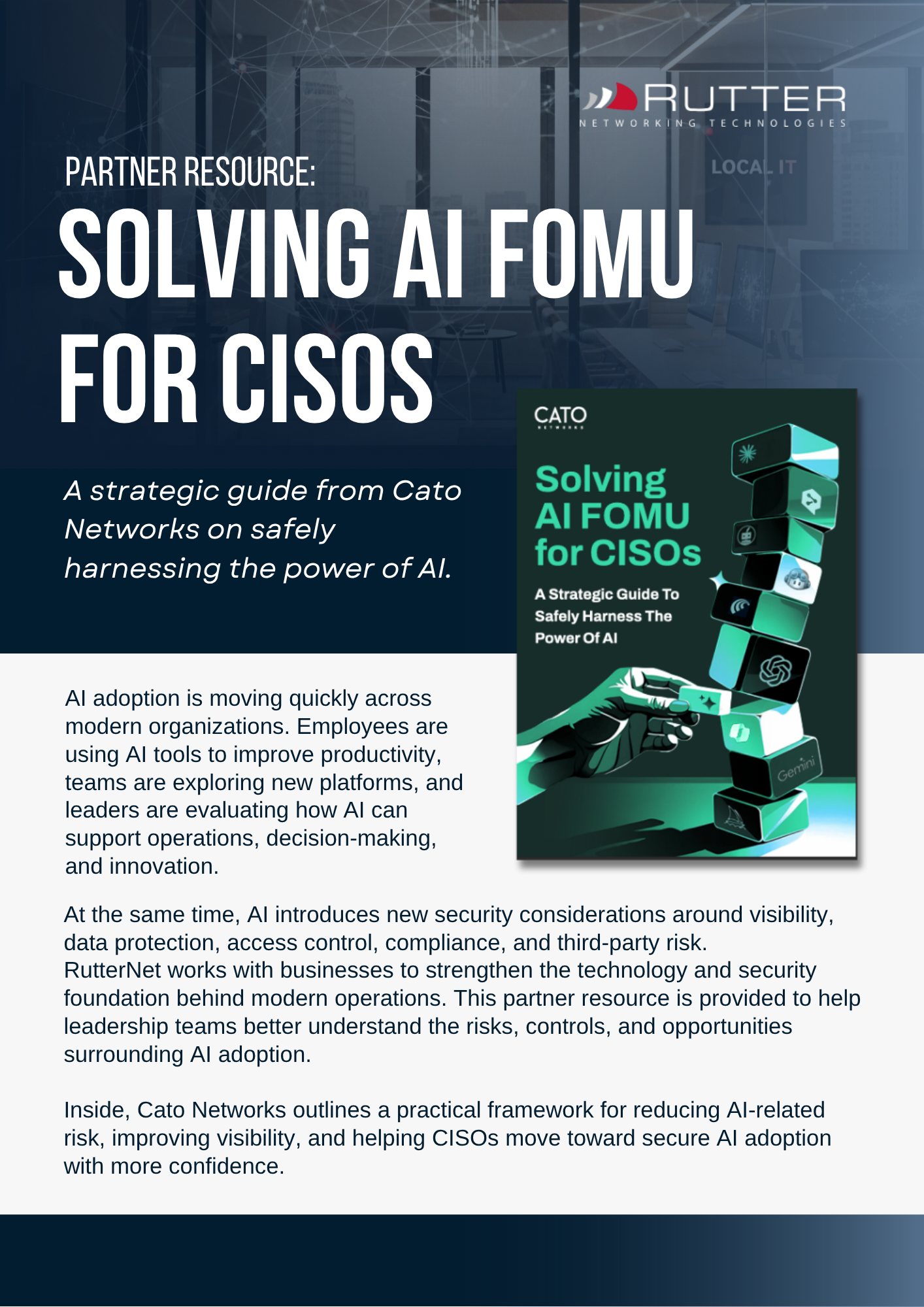
This guide from Cato Networks explores how CISOs and leadership teams can reduce AI-related risk, improve oversight, and build a more secure path for AI adoption.

As organizations evaluate AI tools and their security implications, Rutter helps businesses think through the infrastructure, access, governance, and cybersecurity layers needed to support responsible adoption.

A Proven Framework for Secure AI Adoption

AI adoption should not be blocked, but it does need to be understood, governed, and secured.

This four-step framework gives CISOs and security leaders a clear, actionable blueprint to align AI adoption with enterprise security. Grounded in industry best practices, it helps organizations move forward with more confidence while reducing unnecessary exposure.

1. Discover and Inventory AI Usage

Gain visibility into the AI tools being used across the organization, including both approved applications and unsanctioned tools. Shadow AI can create blind spots for security teams, especially when employees use free or unmanaged platforms to complete everyday work.By identifying where AI is already in use, organizations can begin closing visibility gaps and building policies around real employee behavior.

2. Classify Workflows and Data Sensitivity

Write a brief description of the product's capabiaNot every AI use case carries the same level of risk. Organizations need to understand how AI is being used, what workflows it supports, and what types of data may be involved.This includes mapping sensitive information, business-critical processes, regulated data, and workflows that may require stronger oversight or access controls.lities

3. Monitor Adoption and Business Impact

AI security is not only about restriction. It is also about understanding where AI is creating value and where additional guardrails are needed. Monitoring employee usage can help leadership measure adoption, evaluate productivity gains, identify risk patterns, and determine where AI is delivering real business impact.

4. Govern Data Use and Third-Party Risk

Many AI applications can store, train on, or learn from company data. Organizations need a clear process for reviewing AI vendors, external APIs, data residency practices, training policies, model integrity, and compliance requirements before approval. A stronger governance process helps reduce the risk of data leakage, compliance gaps, and unintended exposure through third-party AI tools.

  • Why Shadow AI is already a security concern for many organizations
  • How AI adoption creates new risks around data leakage, compliance, and prompt-based attacks
  • Why visibility is the first step toward control
  • How Zero Trust and SASE can support safer AI adoption
  • Why AI security should become part of ongoing governance, not a one-time review
  • How leadership teams can begin building a 90-day action plan for more secure AI use

Secure AI Adoption Starts With Visibility

AI can help organizations move faster, but unmanaged AI use can introduce risk just as quickly. The first step is understanding where AI is already being used, what data is involved, and where policies or controls may need to evolve.

RutterNet helps businesses evaluate the technology, cybersecurity, and governance considerations behind modern AI adoption, so leadership teams can move forward with better visibility and stronger protection.

Fill out the form to download the 'Solving AI FOMU for CISOs' guide

CATO_eBook_Solving+Ai+Fomu.Rutter.pdf

Why This Matters

AI adoption is moving faster than most organizations can formally govern. Employees are using public AI tools, teams are exploring sanctioned platforms, and leaders are evaluating how AI can improve productivity, decision-making, and innovation.

Without visibility and clear controls, that momentum can create new risk. Sensitive data may be entered into unmanaged tools, access policies may not keep pace with usage, and third-party AI platforms can introduce compliance, privacy, and security concerns.

This guide helps CISOs and leadership teams understand how to move forward safely, with a practical framework for reducing Shadow AI risk, improving oversight, protecting data, and building a more secure path for AI adoption.

Who This Guide Is For

This guide is designed for leaders responsible for balancing AI adoption with security, compliance, and operational control.

It is especially useful for:

  • CISOs and security leaders evaluating AI-related risk
  • CIOs and IT leaders supporting secure AI adoption across the organization
  • Compliance and risk teams concerned about data exposure, privacy, and third-party AI tools
  • Executive leadership teams deciding how AI should be governed
  • Organizations already seeing employee use of public or unsanctioned AI tools
  • Businesses exploring Microsoft Copilot, ChatGPT Enterprise, Gemini, custom AI applications, or AI agents

If your organization is using AI, evaluating AI platforms, or unsure where AI tools are already showing up, this guide can help clarify the risks, controls, and governance steps needed to move forward safely.

Built for Modern Infrastructure Environments

Modern organizations need AI security strategies that work across cloud applications, hybrid infrastructure, remote users, sanctioned platforms, and the tools employees are already using.

Rutter helps businesses strengthen the technology foundation behind secure AI adoption, including identity and access controls, cloud security, network visibility, data protection, endpoint management, compliance alignment, and ongoing cybersecurity operations.

This guide supports that larger conversation by helping leadership teams understand where AI risk begins, how to improve visibility, and what controls are needed to adopt AI without creating unnecessary exposure.

Key infrastructure considerations:

  • Identity & access control
  • Cloud security visibility
  • Data protection policies
  • Third-party AI risk

Read more